



One thing that sets our industrial team apart is their ability to travel nationwide and support clients at sites across the country. To give you a closer look at what that experience is like, we sat down with Project Manager, Mitch Danner.
Mitch recently wrapped up a project with Ball Corporation and has a unique story to tell about his travels on the road.
Mitch, what made the Ball Corporation Findlay project stand out from others you’ve worked on?
This project was unlike anything I’ve ever been involved with. From mass concrete foundations to heavy steel mezzanines, large equipment installations, and even steel studs and drywall—we were hands-on with every aspect. We ran seven crews, two shifts, seven days a week for months. It was fast-paced and intense, but it really showcased our growth as individuals and as a team. It proved the level of service we can provide to our clients, even under pressure.
What were some of the most interesting components of the project?
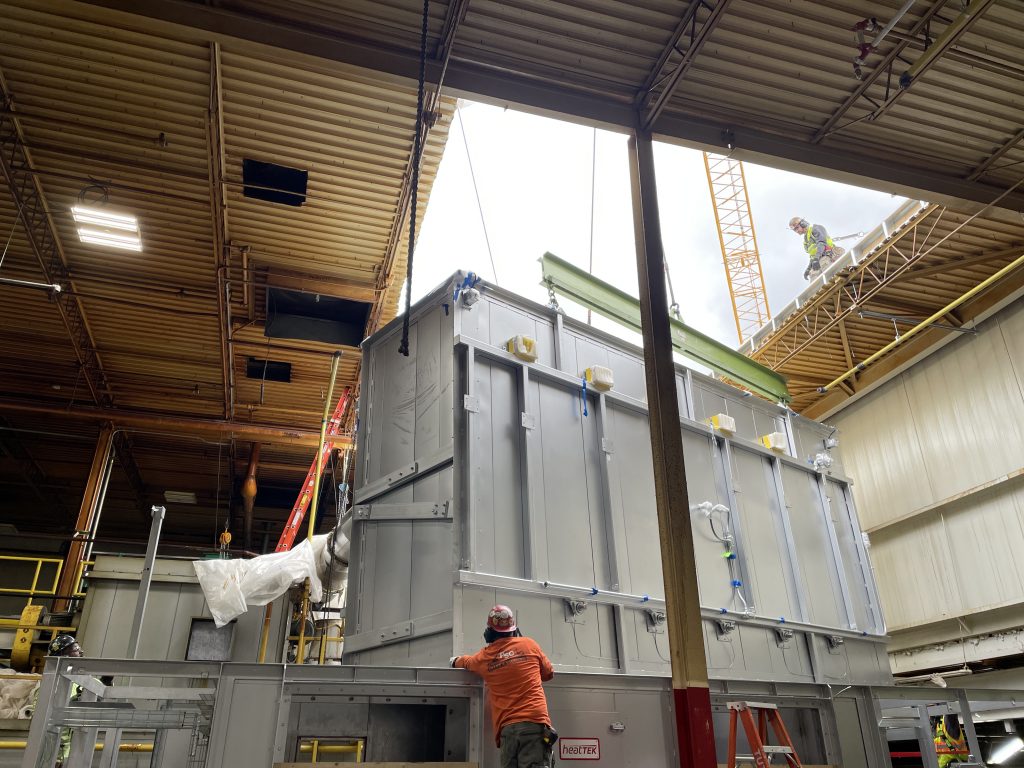
There were quite a few! The mass foundations, the maze-like structural mezzanine, and the incredible length of conveyors were all impressive. But the most memorable moment for me was setting the pin ovens on the second floor. We removed a section of the roof and used a 650-ton crane with 200 feet of luffing jib to swing two 30,000-pound sections of equipment into place. We lowered them through the roof, rotated them 90 degrees, bolted them together, and tilted them to 13 degrees. That operation took weeks of planning and walkthroughs—it’s something I’ll never forget.
Can you share some project stats to give readers a sense of scale?
Absolutely. Here’s a snapshot:
- 6,560 LF of Conveyance Equipment
- 211 Pieces of Individual Equipment
- 135,000 lbs – Largest Piece of Equipment
- 1,953 CY of Concrete
- 25,773 SF of Structural Platform
What was your experience like living and working in Findlay?
Findlay was a great place to be. I actually met my wife while working there! We spent a lot of time exploring restaurants and activities in both Findlay and Dayton. Travel work gives you a unique opportunity to see different parts of the country on someone else’s dime. I’ve heard of crew members visiting Yosemite and Arches while on the road. Personally, I’ve spent time in Yellowstone during travel projects.
How has travel work impacted your career development?
Travel work has been a catalyst for accelerated growth. In the Industrial Division, we experience compressed project timelines. What might take months on a typical job happens in days or weeks for us. That means rapid exposure to all scopes of work, which boosts our construction knowledge and leadership skills. We coordinate closely with owners, manage engineering partners, and detail scopes and schedules with subs. It’s intense but incredibly rewarding.
What are some benefits of travel work?
The financial incentives can be significant. Most travel projects offer weekly travel pay, per diems, and plenty of overtime. It’s tough being away from family, but as one crew member put it: “I work on the road to provide the life my family wants to live.” That’s not always possible working locally in Wisconsin.
Our field crews become like family—we live together, eat together, and work together. The bonds we form go well beyond the job site. There are people I’ve worked with that I’d call on in my personal life without hesitation. We look out for each other and share the workload to get the job done the Cullen Way—not just for the company, but for each other.
What future opportunities are available with JP Cullen?
We’re always looking for help for travel work. Projects range from a few days to over a year, depending on your interest. For example, I’ve just did a spray nozzle replacement project in Southern California, just an hour from Yosemite. We need five crew members and one engineer to travel for the weekend, work three 12-hour days, and wrap it up. That’s a great way for an engineer to earn an extra $1,500 in a weekend.
Any final thoughts for those considering travel work?
I’m a strong advocate for travel work. It’s not always easy, but it’s worth it.
